Football Clubs and Sustainability Alignment
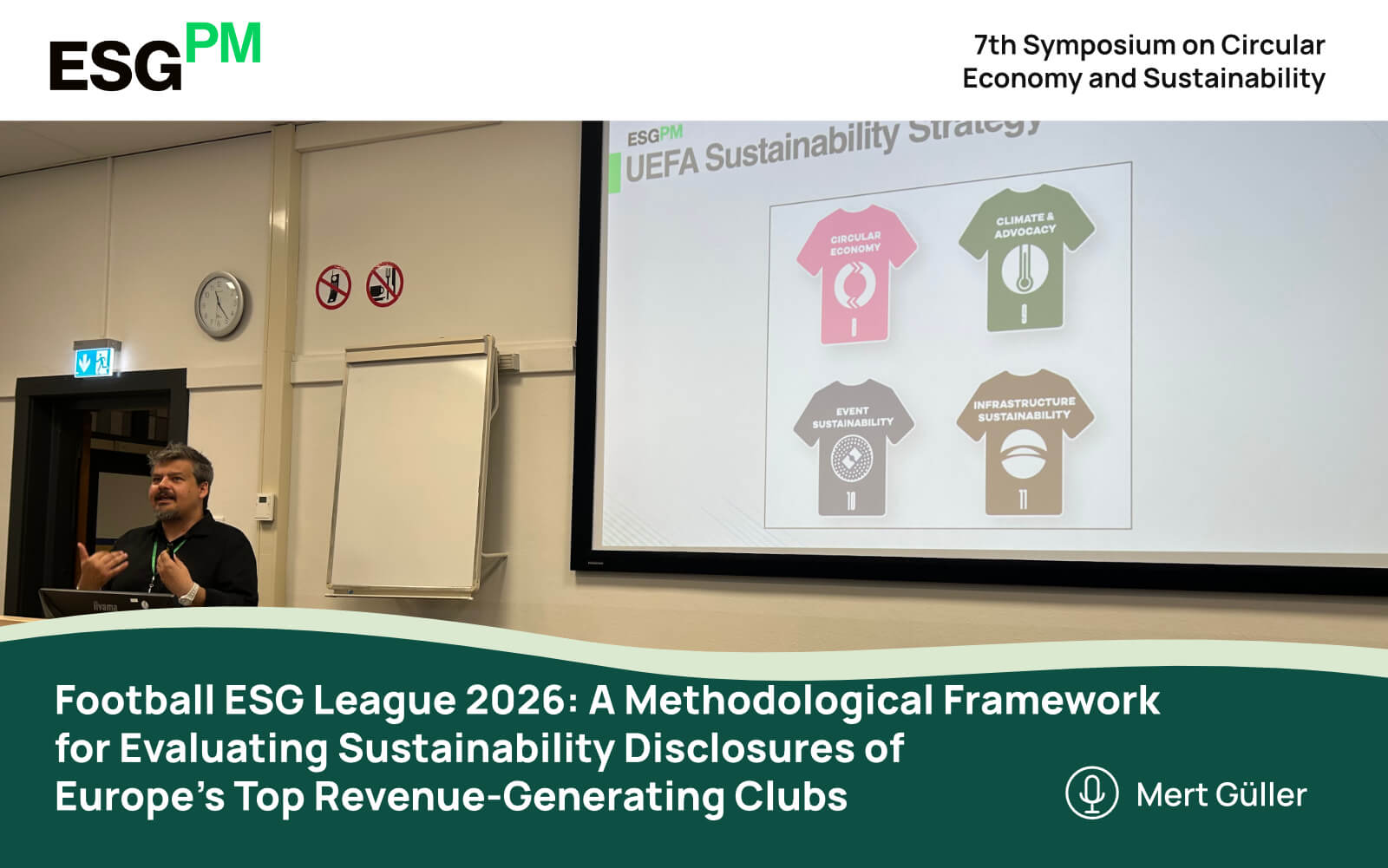
As ESG PM, we supported the 7th Symposium on Circular Economy and Sustainability, held in Maastricht on 24–26 June 2026, as a sponsor and shared our academic study with an international audience.
7th Symposium on Circular Economy and Sustainability Hosted by Zuyd University of Applied Sciences, with contributions from academic institutions including the Technical University of Crete, Harokopio University of Athens, and Democritus University of Thrace, the symposium featured nearly 100 paper presentations. This widely attended event brought together researchers, academics, and practitioners working in circular economy and sustainability.
During the Sustainable Business and Economics session, Mert Güller presented the study titled “Football ESG League 2026: A Methodological Framework for Evaluating Sustainability Disclosures of Europe’s Top Revenue-Generating Clubs.”
Through this study, we sought to answer a fundamental question: To what extent do Europe’s largest football clubs by revenue disclose their sustainability policies, targets, and performance publicly and in a comparable format?
Economic scale creates greater responsibility
The study began with the world’s 20 highest revenue-generating football clubs listed in the Deloitte Football Money League 2026 report. According to Deloitte, these clubs generated more than €12.4 billion in total revenue during the 2024/25 season, setting a new record.
Based on our calculations, the 20 clubs’ combined revenue reached €12.41 billion in 2025, with average revenue of €620.5 million per club. Compared with 2024, both total and average revenue increased by approximately 12.2%.
To illustrate the scale of this economic activity, we compared the clubs’ combined revenue with the current market capitalizations of major European companies operating in other sectors. Annual revenue and company market capitalization are, of course, not the same financial metric. However, the comparison shows that football clubs should no longer be viewed only as sporting organizations, but also as economic actors with extensive supply chains, large-scale infrastructure, global brands, and millions of stakeholders. The €12.41 billion in combined annual revenue generated by Europe’s 20 highest-earning football clubs exceeds the market capitalization of Renault (€8.12 billion), Prada (€10.57 billion), and Carrefour (€11.46 billion), and is close to that of MAPFRE (€13.20 billion) and Continental (€14.70 billion).
At ESG PM, we approach sustainability responsibility based not only on an organization’s legal status, but also on the economic, environmental, and social impact it creates. The growing economic power of football clubs brings with it the need for more systematic ESG management and more transparent disclosure.
An initial five-criterion assessment model
In developing the methodological framework, we drew on UEFA’s Strength Through Unity – Football Sustainability Strategy 2030. UEFA structures its environmental work around four core policy areas:
- Climate and Advocacy
- Circular Economy
- Event Sustainability
- Infrastructure Sustainability
UEFA also emphasizes that measurement and reporting are essential for demonstrating the football sector’s progress on sustainability.
Based on this framework, we defined five initial criteria for assessing clubs’ public disclosures:
- Is there a dedicated sustainability page directly accessible from the home page?
- Is there a publicly disclosed net-zero target?
- Has a circular economy policy been published?
- Has a carbon footprint calculation or report covering Scope 1 and Scope 2 emissions been disclosed?
- Does the club’s stadium hold a green building certification?
Each criterion was scored out of three points, creating a total disclosure score of 15. This scoring system is not intended as a final ESG rating covering clubs’ entire sustainability performance. It was designed as a starting model that evaluates the accessibility of public information and the presence of certain fundamental environmental commitments.
What do the initial results show?
Tottenham Hotspur met all five criteria and ranked first with 15 points. FC Barcelona and Borussia Dortmund each scored 12 points, while some high-revenue clubs ranked lower on sustainability disclosure despite their strong position in the financial rankings.
One of the most striking findings was the significant difference in disclosure maturity among the clubs. Some clearly publish their net-zero targets, emissions data, and infrastructure certifications, while at others even basic sustainability information was difficult to find.
An important distinction must be made here: the absence of disclosure does not necessarily mean the absence of action. Likewise, publishing a policy alone does not prove strong environmental performance. In the next stages of the study, we will therefore also assess the quality of disclosures, measurable targets, verified data, and changes in performance over time.
At ESG PM, our aim is to develop methodologies that adapt general ESG standards to the specific operations of different sectors and that are comparable, open to improvement, and useful in decision-making. The Football ESG League 2026 study is the first step in this approach to making the relationship between economic power and sustainability transparency in the football sector more visible.